
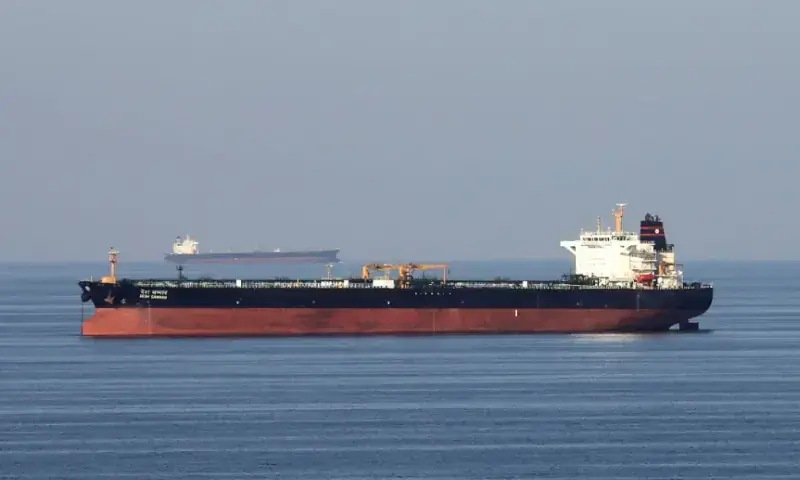
Global Oil Markets Rally After Strait of Hormuz Disruption
International oil prices surged sharply on Monday, climbing as much as 13 percent after shipping operations in the strategically vital Strait of Hormuz were disrupted amid escalating conflict involving Iran, Israel, and the United States.
The spike followed retaliatory Iranian attacks after initial airstrikes reportedly killed Iranian Supreme Leader Ali Khamenei, triggering a wave of geopolitical instability across the Middle East.
Brent and WTI Hit Multi-Month Highs
Brent crude futures jumped to $82.37 per barrel — the highest level since January 2025 — before trimming gains to trade at $78.28, up 7.4 percent in early trading.
Meanwhile, US West Texas Intermediate (WTI) crude climbed to an intraday peak of $75.33, marking its highest point since June. It later settled at $71.76, still up more than 7 percent.
Both benchmarks reacted strongly to sustained exchanges of attacks in the Gulf region that damaged oil tankers and disrupted shipments through the Strait of Hormuz — a narrow but critical waterway linking the Persian Gulf to the Arabian Sea.
Why the Strait of Hormuz Matters
Roughly one-fifth of the world’s daily oil supply passes through the Strait of Hormuz, including exports from Saudi Arabia, the United Arab Emirates, Iraq, Iran, and Kuwait.
The route is also crucial for transporting refined products such as diesel, jet fuel, and gasoline to major Asian economies like China and India.
Shipping data revealed that more than 200 vessels, including oil and liquefied natural gas tankers, dropped anchor outside the Strait. Reports also confirmed damage to three tankers and the death of one crew member during attacks in Gulf waters.
Asian Economies Assess Supply Options
Countries heavily dependent on Middle Eastern oil are evaluating contingency plans. South Korea is considering releasing petroleum from strategic reserves if disruptions continue, while India is exploring alternative shipping routes.
The situation is being closely monitored in Pakistan, China, India, the United States, the United Kingdom, and the European Union due to potential ripple effects on inflation, fuel prices, and economic stability.
OPEC+ Announces Output Increase
Amid rising tensions, the OPEC+ alliance agreed to a modest production increase of 206,000 barrels per day for April.
Energy market analysts note that most OPEC+ producers are already operating near maximum capacity, with Saudi Arabia being one of the few nations able to significantly adjust output.
The International Energy Agency (IEA) confirmed it is coordinating with key Middle Eastern producers and stands ready to facilitate strategic petroleum reserve releases if necessary.
Market Outlook and Price Forecasts
Investment banks are forecasting continued volatility. Analysts at Citi expect Brent crude to trade between $80 and $90 per barrel this week, depending on how the conflict evolves.
Goldman Sachs reported that global visible oil inventories stand at 7.827 million barrels — sufficient for approximately 74 days of demand, which aligns with historical averages.
Impact on US Fuel Prices and Politics
In the United States, gasoline futures surged by over 9 percent to $2.496 per gallon — the highest level since July 2024 — before easing slightly.
Rising fuel prices could create political pressure for Donald Trump and the Republican Party ahead of upcoming midterm elections, as American consumers face the possibility of gasoline exceeding $3 per gallon nationwide.
Global Economic Implications
Financial markets are pricing in a geopolitical risk premium, though some analysts suggest the surge may reflect precautionary trading rather than a full-scale supply crisis — at least for now.
If the Strait of Hormuz remains partially or fully closed for an extended period, experts warn that oil shortages and further price spikes could impact global trade, inflation rates, and economic growth worldwide.
Zavia Pakistan will continue to monitor developments in global energy markets and provide timely updates on oil prices, Middle East tensions, and economic implications.
